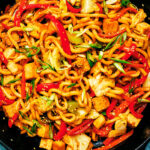
Vegan Yaki Udon (Stir Fried Udon Noodles)
This easy Vegan Yaki Udon is ready in 20 minutes, made with simple pantry ingredients, and packed with protein. Thick udon noodles get stir-fried with crispy tofu, veggies, and a savory umami sauce. Plus, learn the secret to getting long, bouncy noodles—not broken ones! (Vegan, Vegetarian).
Servings: 3
Ingredients
Udon Noodles
- 14 oz cooked udon noodles (from package, see note 1)
- 2 teaspoons grapeseed oil (or other neutral oil)
Tofu
- 1 tablespoon grapeseed oil (or other neutral oil)
- 12 oz cubed extra firm tofu (½-inch/1.3 cm cubes)
Stir Fry Vegetables
- 1 tablespoon grapeseed oil (or other neutral oil)
- 1 sliced red bell pepper (or orange or yellow bell pepper)
- 1 large sliced carrot (2-inch/5cm long matchsticks)
- 1 stalk sliced celery (¼-inch/0.6 cm half-moons)
- 1 cup chopped green cabbage (see note 2)
- 2 thinly sliced scallions/green onions (more for garnish, optional)
- 2 tablespoons toasted sesame seeds
Sauce
- ¼ cup tamari
- 2 cloves minced garlic
- 1 tablespoon brown sugar
- 2 teaspoons toasted sesame oil
- 1½ teaspoons rice vinegar
- 1 teaspoon sambal oelek or sriracha (see note 3)
Instructions
- Sauce: In a small bowl (or jar), add ¼ cup tamari, 2 cloves minced garlic, 1 tablespoon brown sugar, 2 teaspoons toasted sesame oil, 1 teaspoon sambal oelek or sriracha, 1½ teaspoons rice vinegar. Stir (or shake) to mix.
- Udon Noodles: Take 14 oz cooked udon noodles out of the package(s) and place in a medium heatproof bowl. Pour boiling water over the noodles until completely covered. Let sit for 90 seconds, then gently ease the noodles apart using tongs or chopsticks. Use a strainer to drain noodles. With noodles still in the strainer, drizzle 2 teaspoons grapeseed oil and gently toss with your fingers to coat. Set noodles aside in strainer.
- Tofu: Warm 1 tablespoon grapeseed oil in a large nonstick skillet over medium heat (see note 4). Spread out 12 oz cubed extra firm tofu and cook until golden brown on most sides, 6 to 8 minutes. Transfer tofu to a shallow bowl, drizzle with 1 tablespoon of the Sauce. Toss to coat, then set aside.
- Stir Fry: Return skillet to medium heat (no need to clean). Add 1 tablespoon grapeseed oil, then cook 1 sliced red bell pepper, 1 large sliced carrot, 1 stalk sliced celery, and 1 cup chopped green cabbage until tender-firm (not fully cooked), 2 to 3 minutes. Add udon, all the remaining Sauce, 2 thinly sliced scallions/green onions, and 2 tablespoons toasted sesame seeds. Toss until noodles are well coated. Scatter in tofu. Cook for 2 minutes to let the flavors meld—taking care not to overcook noodles. Taste and adjust seasonings if needed. Divide into bowls. Garnish with more scallions if desired.
Notes
- Udon Noodles: Find fresh cooked udon in vacuum-sealed bags with refrigerated noodles or on the shelf with Japanese ingredients. For frozen udon, boil until tender (1 minute less than package directions), drain well and toss with the oil to prevent sticking.
- Green Cabbage: You can substitute Napa cabbage, Savoy cabbage, or baby bok choy.
- Sambal Oelek: This versatile Indonesian chile paste (hot sauce) adds a bit of heat and brightness. You can substitute Sriracha or ½ teaspoon minced ginger—or if you don't want any heat, just leave it out.
- Skillet: I recommend a non-stick skillet no smaller than 10-inches (25 cm) for one batch. A 12-inch (30 cm) is more ideal, as it gives you more space for cooking. I slightly prefer the tofu cooked in a non-stick skillet, because the exterior gets more evenly golden and crisp. But a well-seasoned cast-iron skillet works too.
- Storage Tips: Keep leftovers in the fridge and enjoy within 3 days. To reheat, ise a lightly oiled non-stick or cast-iron skillet or a microwave.
- Serving Size: Serves 2 to 3, depending on how hungry you are!
Nutrition
Calories: 472kcal | Carbohydrates: 52g | Protein: 21g | Fat: 21g | Saturated Fat: 2g | Polyunsaturated Fat: 12g | Monounsaturated Fat: 4g | Sodium: 2047mg | Potassium: 645mg | Fiber: 6g | Sugar: 14g | Vitamin A: 5417IU | Vitamin C: 64mg | Calcium: 125mg | Iron: 4mg